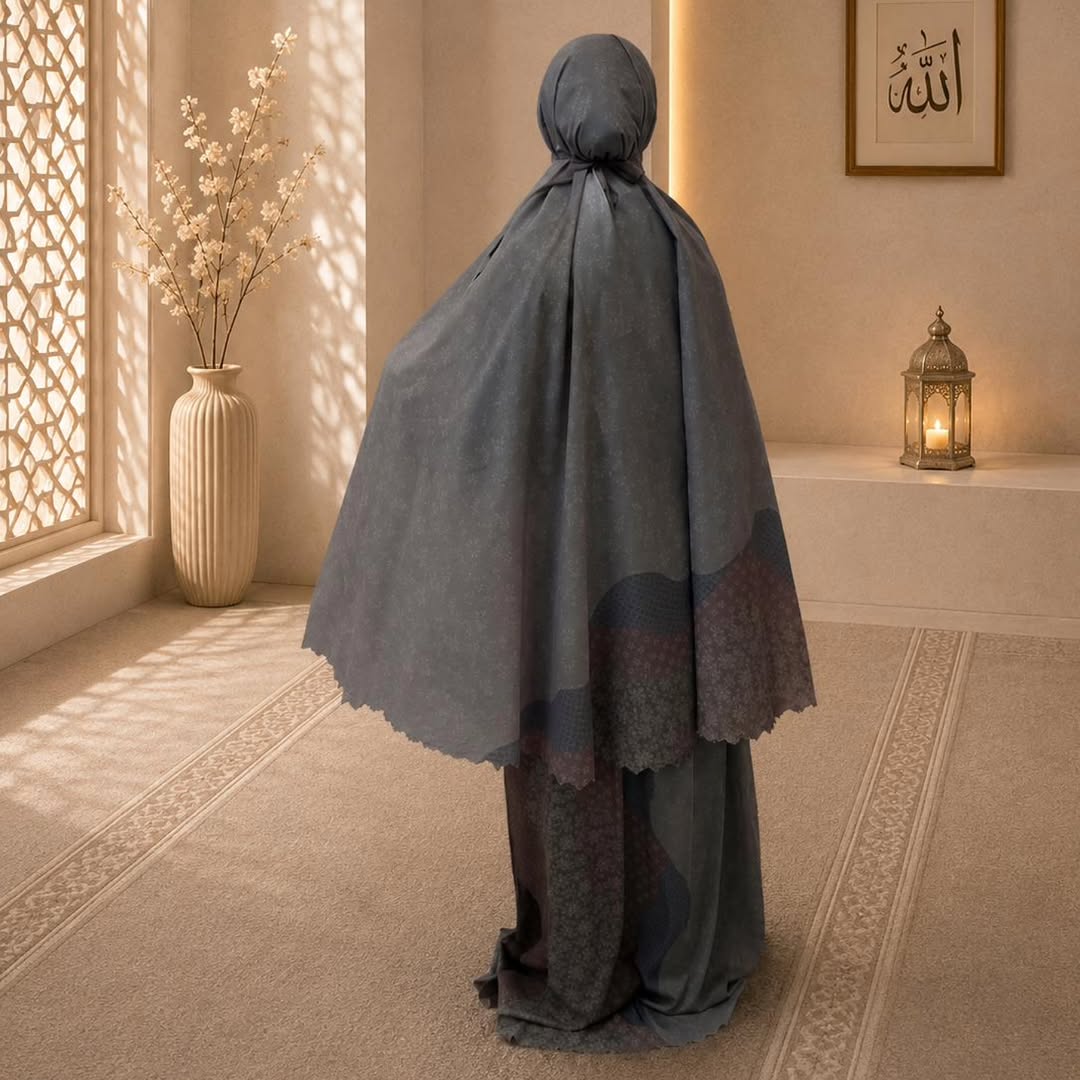
Ask around the Muslim world and you will hear a dozen names for it: isdal in the Gulf and Egypt, mukena in Indonesia, telekung in Malaysia, jilbab de prière in France. In English it is simply the prayer dress — a garment kept aside for one purpose: making salah simple, correct and beautiful.
What does salah require of your clothing?
For a woman’s prayer to be valid, her clothing must cover the entire body except the face and hands, in fabric that is:
- Opaque — skin colour should not show through, even under mosque lighting
- Loose — not tracing the shape of the body in ruku’ and sujud
- Clean — free of impurities
Everyday clothes can meet these conditions, of course. But in practice — leggings that show in sujud, a hijab that slips back mid-rak’ah, a top that rides up — many of us have spent a whole prayer adjusting instead of concentrating. A prayer dress removes the question entirely.
One piece or two?
One-piece prayer dresses pull over the head — nothing to align, ideal for children and for keeping by the bed for Fajr. Two-piece sets (a khimar covering to the waist or hips, plus a full skirt) are more breathable, easier to size, and much faster to fold small — which is why the two-piece is the format we chose for the Maison Haya travel sets.
Why keep a dedicated prayer garment?
- Zero friction. The adhan sounds, you slip it on over whatever you are wearing, and you are ready. No outfit audit.
- Guaranteed coverage. Designed for sujud: no gaps at the wrist, no hem lifting, chin coverage that stays put.
- Cleanliness. Your prayer clothes stay reserved for prayer — worn minutes a day, always fresh. (See how to care for prayer clothes.)
- Presence of heart. The Prophet ﷺ was distracted in prayer by a patterned garment and asked for it to be taken away (al-Bukhari). A garment that only means prayer does the opposite: putting it on becomes a ritual that tells your mind, we are standing before Allah now.
- Hospitality. A spare set means any guest can pray comfortably at your home — a small kindness with a big reward.
How to choose a good one
- Fabric first. In the Gulf climate, look for lightweight woven fabrics that breathe and do not cling with static. Avoid anything shiny-thin that needs a slip underneath — that defeats the purpose.
- Test the sujud. A good cut keeps your lower back covered when you fold forward, without a metre of extra fabric pooling around you.
- Face opening. It should frame the face snugly without pins and without pressing on the forehead where it meets the ground.
- Portability. If it cannot leave the house, it will only serve half your prayers. Our sets fold into their own matching zip pouch — handbag-sized, so Dhuhr at the office or Asr at the mall is never a problem.
A prayer dress is one of those rare purchases that is used five times a day, every day, for years. Choose one made with care — and it quietly upgrades every single prayer. Explore the Maison Haya collection: free delivery everywhere in the UAE.
Read next: prayer dress fabric in Gulf heat — opacity, breathability and the tests that matter.