Modest Campus Outfits for the New Term in the Gulf

The first week back is the one everybody dresses for. By the third, the real problem has shown itself: a campus in the Gulf in September is a series of temperature shocks — forty-one degrees crossing the car park, nineteen degrees in a lecture theatre with the air conditioning set to arctic, and a prayer room somewhere in between.

Dressing modestly is not the difficulty. Dressing modestly for four different climates in one day, in clothes you can also pray in, is. Here is how to build a term’s worth of outfits around that, without buying a new wardrobe.

Start with the layer that never comes off

Everything works better if the bottom layer is right. A long, loose jersey dress or a wide-leg trouser with a long tunic gives you full coverage before a single accessory is added — which means whatever happens to the outer layer during the day, you are still covered.

Look for viscose, modal, linen blends and lightweight crepe. Avoid polyester that does not breathe: it is the reason a five-minute walk feels like fifteen. We went through the fabric question properly in prayer dress fabric in Gulf heat, and the same rules apply to everyday campus clothes.

Then add the layer you take on and off all day

This is the piece that makes Gulf September wearable: an open abaya, a long cardigan, a light kimono or an unstructured blazer. Outside, it stays open and moves with the air. Inside a cold lecture hall, it closes and becomes the warm layer you would otherwise be shivering without.

Two of these, in colours that go with everything you own, will carry an entire term. Keep one in a locker or the boot of the car if you can — the day you forget it is always the day the air conditioning is at its most enthusiastic.

Shoes decide more than you think

Campus means distance. Between a car park, three buildings and a prayer room, you will walk further on an average Tuesday than you did all summer.

  • Slip-on and closed beats laces: wudu is much easier when shoes come off without sitting down.
  • Leather or canvas loafers, clean trainers, or a low block heel for presentation days. Flat sandals are lovely until the third corridor.
  • Whatever you choose, wear socks. It makes wudu in a shared bathroom far simpler, and it means the prayer room floor is never a consideration.

The colours that survive the heat

September light in the Gulf is harsh and unforgiving, and mid-tones handle it better than either extreme. Sand, olive, dusty rose, deep teal, navy, warm greys — they hide dust, they do not go translucent in direct sun the way white sometimes does, and they photograph well in the flat midday light of a courtyard.

Black still works, and always will, but a full black outfit outdoors at 1pm is a decision your body notices. Save it for the day the timetable keeps you inside.

Dress for the prayer room, not just the classroom

This is the part most campus style guides miss entirely. The outfit that looks right for a seminar sometimes makes salah awkward: a fitted sleeve that rides up in sujud, a hem that sits wrong when you kneel, a scarf that needs re-pinning afterwards.

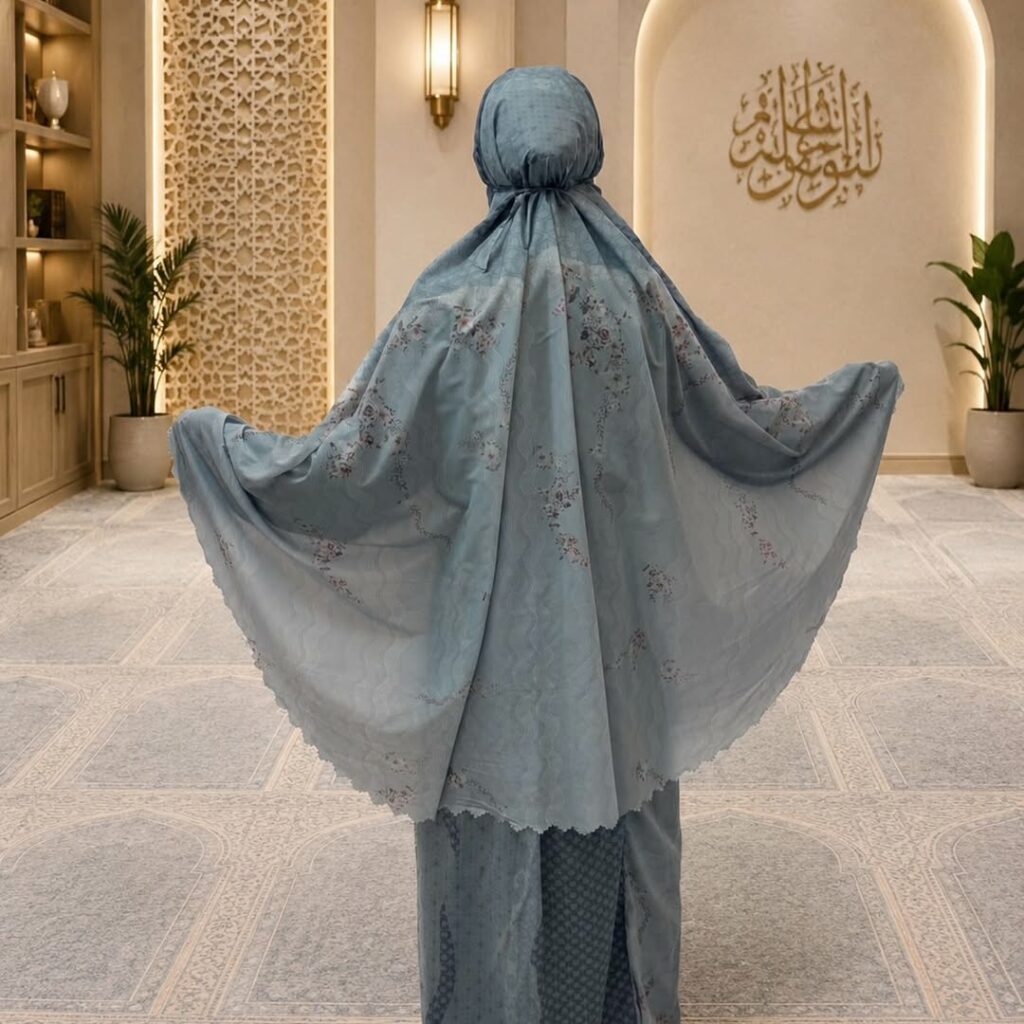
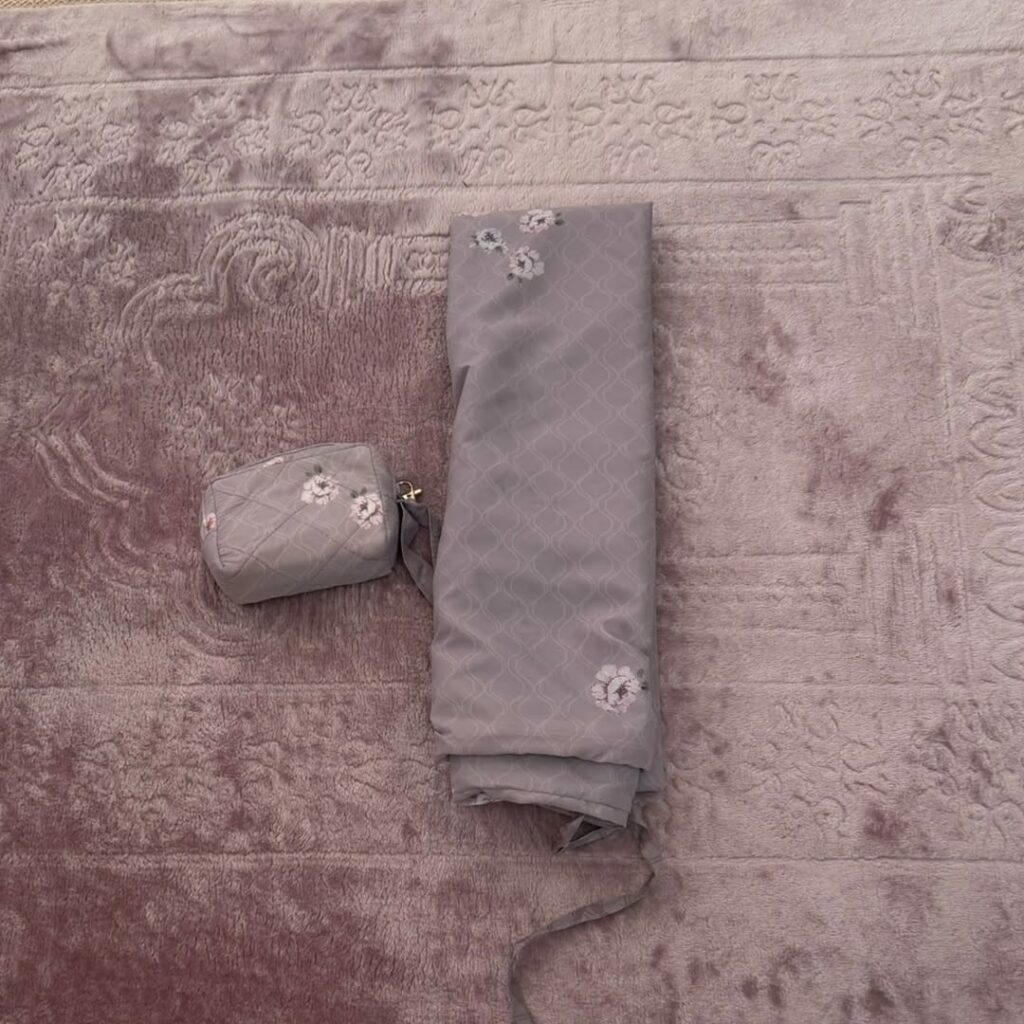
The simplest fix is to stop asking your outfit to do both jobs. A folded two-piece prayer set in your bag goes on over whatever you are wearing in about thirty seconds, covers everything properly, and comes off just as fast — and it means you can dress for the day you are actually having. Ours folds into its own pouch, small enough to sit next to a laptop. For the fuller comparison with an abaya, see prayer dress vs abaya.

Five outfits that cover a week

  • Sunday, back into it: jersey maxi dress, open linen abaya, loafers, plain scarf. Nothing to think about on the hardest morning of the week.
  • Monday, long day: wide-leg trousers, long tunic, cardigan, trainers. The most walkable outfit you own.
  • Tuesday, presentation: crepe midi dress, unstructured blazer, low block heel, silk-feel scarf in a mid-tone.
  • Wednesday, library: soft knit tunic, straight trousers, slip-ons. Warm enough for four hours of air conditioning.
  • Thursday, out afterwards: the Sunday dress with a better scarf, a bag that is not the rucksack, and the same shoes. Nobody notices the repeat; everybody notices a rushed outfit.

Five outfits, roughly eight pieces. The discipline is in the colour palette, not the quantity — if everything works with everything, mornings stop being a decision.

What to keep in the bag

A spare scarf, a spare pair of socks, hijab pins in a small tin, and the prayer pouch that lives there permanently. That is the whole kit, and it weighs less than a full water bottle. The complete list is in back-to-school bag essentials for Muslim women.

Frequently asked questions

How do I stay modest without overheating in September?

Loose beats light. A wide, flowing cut in a breathable natural fibre is cooler than a fitted garment in a technical fabric, because it moves air. Coverage is not the thing making you hot — a tight polyester sleeve is.

Can I wear jeans on a Gulf campus?

On most campuses yes, with a long tunic or a longline shirt over them. Check your institution’s dress code once at the start of term; several in the region are more specific than students expect, and it is a five-minute read that saves an awkward conversation.

Do I need a separate outfit just for praying?

Not strictly — you need clean clothing and proper coverage. But a dedicated set removes the daily calculation and takes thirty seconds to put on, which in practice is the difference between Dhuhr at 12:40 and Dhuhr at 3pm.

Read next: what to wear in Dubai — the same principles, off campus.
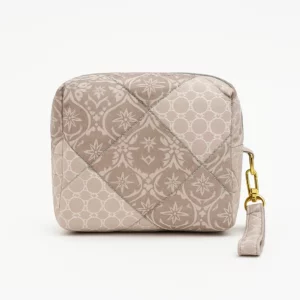
Maison Haya Travel Prayer Set folded in its matching pouch

Travel Prayer Set — folds into its own pouch

A lightweight two-piece prayer outfit, cut from a limited length of printed fabric — no two sets are alike.

95 AED  ·  free delivery everywhere in the UAE  ·  14-day returns
Shop the collection

How to Set Up a Prayer Corner in a Student Room

A new term usually comes with a new room. A dorm at a university in Al Ain, a shared flat in Dubai Marina, a bedroom at home rearranged around a desk that was not there in June. And somewhere in that rearranging, the place where you pray tends to become wherever there happens to be floor.

That works, technically. Salah is valid on any clean surface, and the Prophet ﷺ told us the earth has been made a place of prayer and a means of purification. But there is a real difference between praying wherever you land and walking three steps to a corner that exists for nothing else. The first depends on your willpower at 1pm on a Wednesday. The second does not.

Here is how to set one up, in a room you may not be allowed to drill a hole in.

Choose the corner before you decorate it

Three practical constraints decide the spot, and you can check all of them in two minutes.

  • Space to prostrate. You need roughly your own height in clear floor, and enough width to sit comfortably. Measure with your body, not your eyes — kneel down and check your forehead meets floor, not the leg of a desk.
  • Direction. Find the qibla once, with a compass app, and note which wall it is. In most of the UAE it is close to west-north-west; in the Eastern Province of Saudi Arabia you are nearly facing due west. Knowing the wall means you never re-check at speed.
  • Privacy. A corner you can face away from the door is worth more than a bigger space in the middle of the room, especially in shared accommodation.

Avoid the spot directly in front of the wardrobe or under the only window that opens. A prayer corner that blocks daily traffic gets folded away by the second week.

Keep the floor clean without making it precious

A prayer mat that stays down is the whole idea. If housekeeping or flatmates make that impossible, a mat that rolls into a basket by the same corner is the next best thing — still a fixed address, just with a lid.

Under a mat on carpet, a thin foam layer makes a long Isha considerably kinder on the knees. On tile, a folded blanket does the same job for nothing. And keep the corner free of everything else: the moment a laundry pile lands there, the corner becomes storage and stops being a musalla.

Everything you need, within arm’s reach

The point of a prayer corner is to remove every small excuse between the adhan and the first takbir. That means the things you reach for live there, not in three different rooms.

  • A prayer outfit, folded and ready. Not in the wash, not at the bottom of a drawer. A two-piece set that unfolds ready to wear means you never postpone salah to change first.
  • A small basket or tray: misbaha, a pocket Qur’an or a bookmark, and a spare scarf.
  • A hook or a hanger for the mat and the outfit, if floor space is tight. Command strips hold both without touching the paint.
  • A light you control. A small warm lamp for Fajr and Isha, so the overhead light never has to wake the room.

If you keep a second set in your bag for campus — and we would — keep this one separate. The bag set is for the day; the room set is for Fajr and Isha, and it should never be missing because it is in a rucksack somewhere.

Make it beautiful, quietly

You do not need calligraphy on every wall. One considered thing is more effective than five: a single framed piece of Arabic calligraphy, a plain woven mat in a colour you love, a small brass incense burner, a plant that survives air conditioning. The corner should look like a place you want to sit in for twenty minutes, because some evenings you will.

Resist the urge to turn it into a shrine of objects. Empty space is part of what makes a musalla feel calm, and in a student room empty space is the rarest material you have.

Wudu, in a shared bathroom

This is where most dorm prayer routines actually break, not at the mat. Two things fix it: making wudu in the morning and keeping it — it lasts until it breaks, not until lunchtime — and a small towel of your own kept by the door, so the walk back to your room is not a wet one. A pair of slip-on sandals by the bathroom door completes the system.

If the bathroom is down a corridor and you share it with strangers, the full set of workarounds is in how to make wudu while travelling — airports and dorms have the same problem.

Let the corner carry the routine

A physical place does a surprising amount of the work that willpower otherwise has to do. You walk past it twenty times a day, and each pass is a small reminder that costs you nothing. Pair it with the two habits that hold a term together: pray at the start of the window rather than the end, and never let two prayers slide in a row — if one goes, the next one is non-negotiable.

The rest is in staying consistent with salah, which is really a piece about designing your day so that consistency is not a daily act of heroism.

Frequently asked questions

Can I pray in a room with a bed, a desk and posters on the wall?

Yes. The requirement is a clean place and clean clothing, not a bare room. Images of living beings directly in front of you while you pray are best avoided, so if a poster sits on the qibla wall, move it rather than the corner.

My flatmates are not Muslim. Is a visible prayer corner awkward?

Far less than most people expect, and it tends to settle the question once instead of repeatedly. A mat, a hook and a lamp read as a quiet personal space, not a statement — and a corner you do not have to explain each time is a corner you will actually use.

What if there is genuinely no space?

Then the corner becomes a basket: mat, prayer set, misbaha, kept in one place you can reach without thinking. The fixed address matters more than the floor plan.

Read next: how to pray at work or university — the daytime half of the same routine.

Maison Haya Travel Prayer Set folded in its matching pouch

Travel Prayer Set — folds into its own pouch

A lightweight two-piece prayer outfit, cut from a limited length of printed fabric — no two sets are alike.

95 AED  ·  free delivery everywhere in the UAE  ·  14-day returns
Shop the collection

Back-to-School Bag Essentials for Muslim Women in the Gulf

The Gulf academic year restarts in the last days of August, and with it comes the bag. Whether you are heading back to a campus in Sharjah, a school staffroom in Dubai or an office that has quietly filled up again after the summer, the bag you pack on the first Sunday sets the tone for the whole term.

Most back-to-school lists are written for someone whose day has no fixed appointments in it. Yours has five. Dhuhr lands squarely in the middle of a timetable, Asr often catches the end of it, and the difference between praying on time and praying in a rush at 9pm is usually one or two small things you either packed or did not.

Here is what actually earns its place, tested against a Gulf schedule.

1. A prayer set that never leaves the bag

The single most useful item on this list, and the one most women discover late. A folded prayer outfit that lives permanently in your bag removes the daily decision entirely: you are never choosing between praying in what you are wearing and not praying at all.

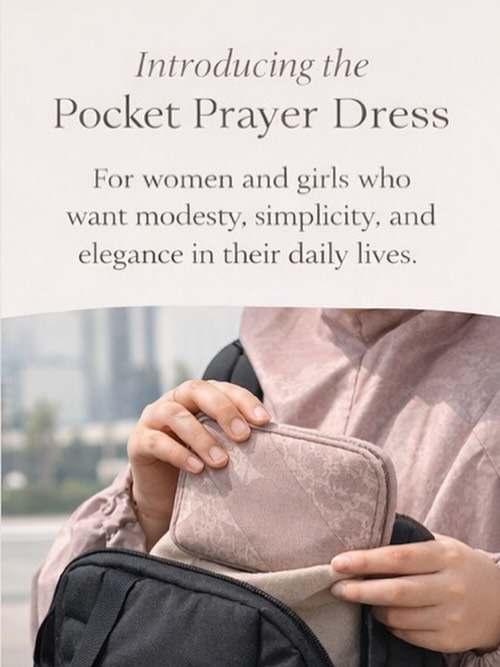
Look for a two-piece cut in a light, wrinkle-resistant fabric with its own pouch, small enough to sit beside a laptop without being negotiated with. Ours folds to roughly the size of a make-up bag, and the point is that you stop noticing it is there. If you are weighing options, we wrote a full comparison in what to look for in a travel prayer set.

2. Socks you can actually wipe over

Shared bathrooms with high, narrow sinks are the real obstacle to wudu on campus — not time, not space. Wearing proper socks in the morning and knowing the ruling on wiping over khuffain turns a five-minute contortion into a ten-second refresh.

Keep a clean spare pair in the bag from day one. By week three, when the abaya sleeve has met a coffee, you will be glad of a spare of most things.

3. One extra scarf, folded flat

A second hijab — or an underscarf, if you only have room for one — costs nothing in weight and solves a surprising number of situations: a spill before a presentation, a long day that turns into an evening, a friend who forgot hers. Choose a neutral that works with everything you own rather than the one you love most.

4. Something clean to stand on

The earth has been made a place of prayer for us, and a clean corner of carpet is enough. But a thin folding travel mat, or even a large plain shawl kept for the purpose, makes a seminar room floor or a quiet corridor feel like a place you chose rather than a place you settled for.

5. Prayer times where you cannot ignore them

Not an app buried in a folder — a widget on your lock screen, with the times for your actual emirate. Then add a silent ten-minute hold for Dhuhr and Asr to your timetable, the way you would for any other commitment. We walked through the full routine in how to pray at work or university, and this is the step people skip.

6. Water, and something to eat standing up

September in the Gulf is still summer in every way that matters. A bottle you will genuinely refill, plus dates or nuts in a small tin, covers the 3pm collapse and the day you discover the canteen queue is twenty minutes long. It is a small sunnah and a practical one.

7. Pins, in a tiny tin

Hijab pins, safety pins, a spare hair tie. They weigh nothing and they migrate to the bottom of the bag unless they live in something with a lid. A mint tin is the classic solution for a reason.

8. A folded tote inside the bag

For the books you did not plan to carry, the gym kit, the groceries on the way home. Flat, light, and it stops your main bag becoming a bin by Thursday.

9. A five-minute reset kit

A small towel or face cloth for after wudu, a roll-on deodorant, a lip balm. Not vanity — the difference between arriving at a 4pm tutorial feeling composed and arriving feeling like the day won.

How to pack it so it survives past week two

The mistake is packing everything loose. Three small pouches beat one large bag every time: one for prayer (outfit, socks, spare scarf), one for reset (towel, deodorant, pins), one for tech. Each one gets checked and refilled on Friday, and nothing else needs thinking about for the rest of the week.

Then keep the prayer pouch in the bag permanently. Not moved between bags, not taken out for the weekend and forgotten on Sunday morning — permanently. The whole value of it is that it is already there on the day you are running late.

Frequently asked questions

Is a prayer set really necessary if I wear an abaya anyway?

Not necessary, no. But an abaya worn all day is not always in a state you would choose for salah, and it rarely solves coverage of the hair and feet at the same time. A prayer set takes thirty seconds to put on over what you are wearing and comes off just as fast. The difference is explained in full in prayer dress vs abaya.

What if my campus has no prayer room?

Almost every Gulf campus, mall and hospital has one, often unmarked on the floor plan — ask security once and you never ask again. Failing that, a bookable meeting or seminar room for ten minutes works, and needs no explanation.

How do I keep it all from getting heavy?

Weigh the bag once, honestly. Most of the weight is books and a laptop charger, not this list — the prayer pouch, socks and scarf together come to less than a full water bottle.

Read next: modest campus outfits for the new term — five outfits that survive a Gulf September, and how to set up a prayer corner in a student room for when you get home.

Maison Haya Travel Prayer Set folded in its matching pouch

Travel Prayer Set — folds into its own pouch

A lightweight two-piece prayer outfit, cut from a limited length of printed fabric — no two sets are alike.

95 AED  ·  free delivery everywhere in the UAE  ·  14-day returns

Shop the collection