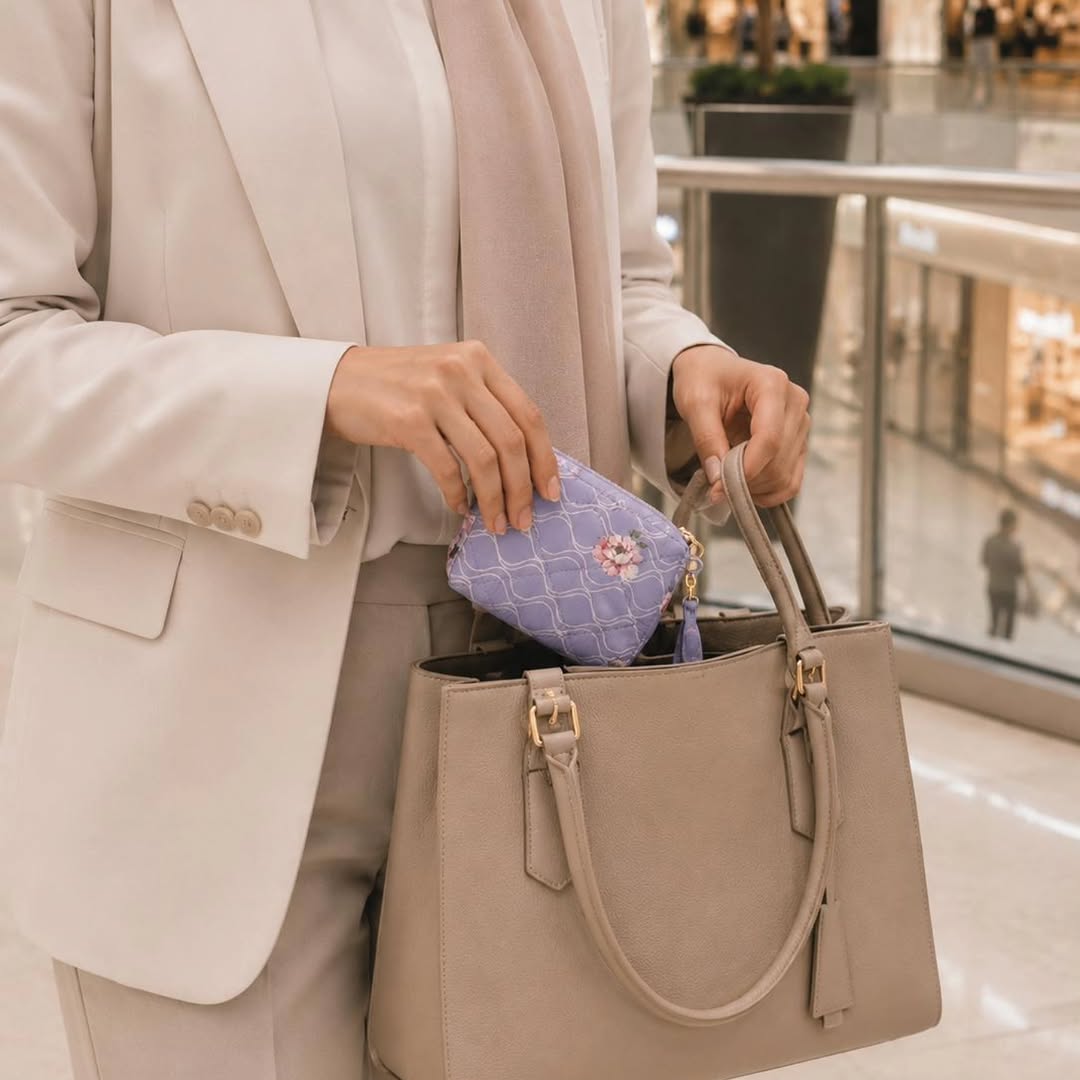
Praying at home is easy. The salah that quietly slips away is the one that falls at 12:40 on a Tuesday — between a meeting and a deadline, or between two lectures on the far side of campus. Dhuhr and Asr sit right in the middle of the working day, and if you have not decided in advance where and how you will pray, the day decides for you.
Here is a practical routine that works in a Gulf office, a hospital shift, a university campus or a co-working desk.
1. Know your windows before the week starts
Most women who miss prayers at work are not careless — they simply never checked when the window closes. Dhuhr in the UAE can run for roughly three hours, Asr a little less, and knowing that changes everything: you stop treating salah as an emergency and start slotting it between two calendar blocks.
Put the prayer times of your actual city into your phone, then add a silent 10-minute calendar hold for Dhuhr and Asr, the way you would for any other appointment. If your timetable genuinely cannot move, aim to pray at the start of the window rather than the end — that single habit removes most of the stress.
2. Find your space (and it does not have to be perfect)
The Prophet ﷺ said that the earth has been made a place of prayer, and that is the whole point: you do not need a mosque, only a clean spot.
- Look for the prayer room first. Almost every mall, hospital, airport, government building and larger office in the Gulf has one — often unmarked on the floor plan. Ask reception or security once, and you never have to ask again.
- Book a meeting room. Ten minutes, recurring, no explanation required. In practice this is the most reliable option in a corporate office.
- On campus: the musalla is usually near the main library or the student centre. Between buildings, an empty seminar room works.
- Bring your own surface. A folding travel prayer mat, or a large shawl, means a carpeted corner is enough.
3. Solve wudu before you solve everything else
Shared bathrooms with high sinks are the real obstacle, not the prayer itself. Two things make it manageable: making wudu at home in the morning and simply keeping it (it lasts until it is broken, not until lunchtime), and knowing the rules for wiping over socks or khuffain so you are not taking off your shoes at a public sink. We covered both in detail in our guide to wudu while traveling — the same techniques apply to a bathroom at the office.
A small pack of tissues and a compact towel in your bag turn a messy sink into a two-minute job.
4. The outfit problem — and the 60-second solution
Here is what actually stops many women: the outfit that is perfectly appropriate for work is not always prayer-ready. A hijab styled tightly around the neck, a blouse that rides up in sujud, trousers that pull at the ankle, sleeves that slide back — you end up adjusting fabric instead of concentrating.
The simplest fix is to keep a travel prayer set in your desk drawer, tote or backpack. It is a two-piece prayer dress with an attached hijab that goes straight over whatever you are wearing, covers you fully in under a minute, and folds back into its own pouch afterwards. No changing room, no undoing your hijab, no rearranging your day. If you are new to the garment, our guide to what a prayer dress is explains how it differs from an abaya.
Keep the pouch in the bag you carry every day rather than the one you carry sometimes — that is the difference between owning one and using one.
5. Praying in front of colleagues
Many women hesitate the first time, and then find it was never an issue. A short, matter-of-fact request works best: “I need ten minutes around one o’clock for prayer — is there a room I can use?” In the Gulf this is entirely normal and usually already accommodated. In a more international office, framing it as a standing calendar block rather than a favour tends to settle the matter permanently.
If you would rather be discreet, pray at the start of your lunch break in a booked room. Discretion is a personal preference, not a compromise.
6. What if you genuinely cannot pray on time?
A demanding shift is not the same as travel. The concessions for shortening and combining prayers apply to a traveller, not to a long day at the desk — we explain the difference in our guide to praying while traveling. If a surgery, a flight duty or an exam genuinely runs through the whole window, pray as soon as you are able and ask a scholar you trust about your specific situation rather than guessing.
What matters most is the pattern over months, not the perfect day. Our notes on staying consistent with salah are written for exactly this kind of busy stretch.
Your desk-drawer prayer kit
- Travel prayer set in its pouch — the one item that solves the outfit question
- Folding prayer mat or a large clean shawl
- Spare underscarf and a few pins
- Small towel and tissues for after wudu
- Clean socks (useful for wiping, and for prayer-room floors)
- Prayer-times app with notifications on, not just badges
Set this up once and Dhuhr stops being a negotiation. It becomes the ten quiet minutes that hold the rest of the day together.
Want a prayer set that lives in your work bag? Explore our Travel Prayer Sets with matching pouch — each one cut from a limited length of printed fabric, so no two are alike. Free delivery everywhere in the UAE.